-
-
-
Bhaganbigha, Biharsharif, Nalanda-803118 (Bihar)
Rohit Kumar
November 27, 2026
FLN in Bihar: A Guide for Future B.Ed & D.El.Ed Teachers
Explore FLN, NIPUN Bharat and practical teaching strategies for future educators pursuing B.Ed and D.El.Ed in Bihar at D.P. Singh Institute of Education.
“A great teacher does not just teach children how to read and count; they lay the foundation for a lifetime of learning.”
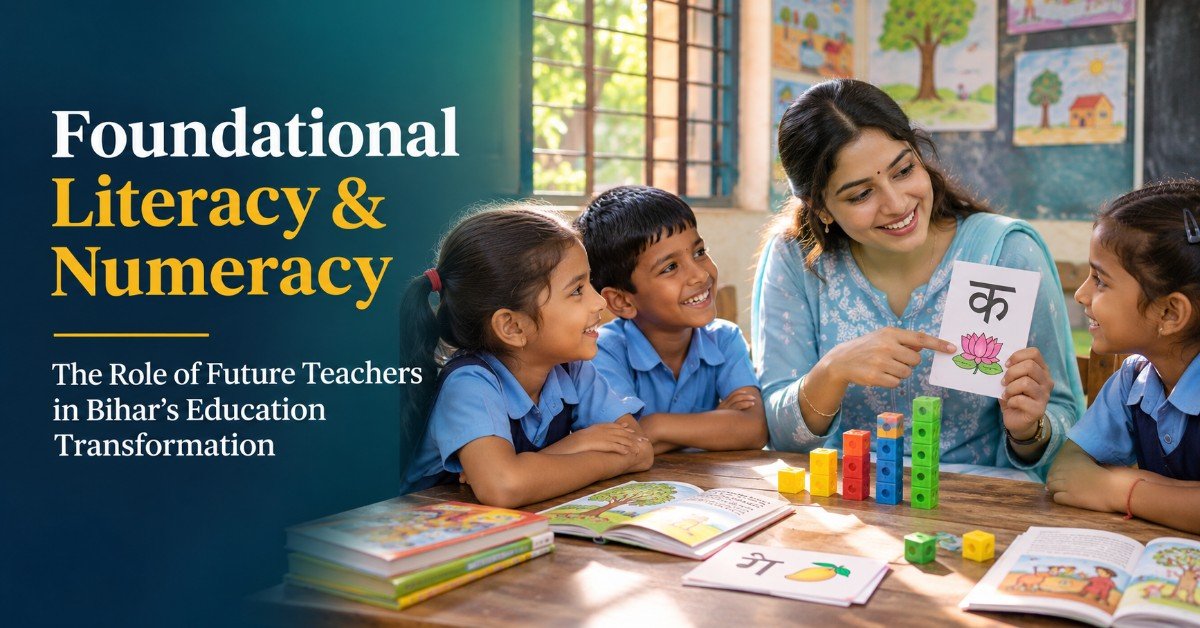
Foundational Literacy and Numeracy (FLN): The Role of Future Teachers in Bihar’s Education Transformation
The future of education in Bihar begins with strong foundational learning. Before children can succeed in science, technology or advanced mathematics, they must develop the essential ability to read, write, communicate and understand numbers. These fundamental competencies are collectively known as Foundational Literacy and Numeracy (FLN).
As India continues to strengthen school education through the National Education Policy (NEP) 2020 and the NIPUN Bharat Mission, professionally trained teachers have an important role in transforming learning outcomes.
For aspiring educators pursuing B.Ed and D.El.Ed at D.P. Singh Institute of Education, located in Bihar Sharif, Nalanda, understanding foundational education can help them prepare for meaningful and responsible teaching careers.
What Is Foundational Literacy and Numeracy (FLN)?
Foundational Literacy and Numeracy refers to essential reading, writing, language and mathematical competencies that children develop during their early years of education. These abilities provide the foundation for future academic success and lifelong learning.
What Is Foundational Literacy?
Foundational literacy is the ability to understand language, communicate effectively, read with comprehension and express thoughts through writing.
Its key components include:
Recognising letters, sounds and words.
Developing listening and speaking abilities.
Reading age-appropriate texts.
Understanding stories and written information.
Developing vocabulary.
Expressing ideas through simple sentences.
What Is Foundational Numeracy?
Foundational numeracy is the ability to understand numbers, mathematical relationships and basic problem-solving concepts.
It includes:
Number recognition and counting.
Basic addition and subtraction.
Understanding shapes and patterns.
Comparing quantities and measurements.
Developing logical reasoning.
Applying mathematics in everyday situations.
Together, literacy and numeracy help children become confident, independent and active learners.
Understanding the NIPUN Bharat Mission
The Government of India launched the NIPUN Bharat Mission in July 2021 to strengthen foundational learning across the country.
NIPUN stands for National Initiative for Proficiency in Reading with Understanding and Numeracy.
The mission aims to help children achieve essential foundational learning competencies by the end of Grade 3.
Key Objectives of NIPUN Bharat
Strengthen reading comprehension and writing abilities.
Improve basic mathematical understanding.
Encourage activity-based and enjoyable learning.
Develop effective teaching competencies.
Support children with diverse educational needs.
Promote continuous assessment of learning progress.
The mission reflects the emphasis placed on foundational education under the National Education Policy 2020.
For future teachers in Bihar, understanding the NIPUN Bharat framework provides valuable insight into the evolving priorities of elementary education.
Why Foundational Education Is Important for Bihar
Bihar has a remarkable educational heritage. From the historic learning traditions of Nalanda to modern educational institutions, education has remained an important part of the state's identity.
Strengthening foundational learning provides an opportunity to continue this legacy and improve educational experiences for future generations.
1. Building Strong Academic Foundations
Children who develop essential reading and mathematics skills during their early years are better prepared to understand more advanced academic concepts.
Strong foundational learning supports future progress in science, mathematics, languages and other subjects.
2. Strengthening Rural Education
Teachers working in rural communities can use locally available materials, familiar stories, traditional games and everyday experiences to make learning accessible.
Effective teaching does not always require expensive technology. Creativity, preparation and professional understanding can make a significant difference.
3. Supporting Inclusive Education
Students enter classrooms with different linguistic backgrounds, abilities and learning experiences.
Professionally trained educators can adapt their teaching approaches to support individual learning needs and create inclusive classroom environments.
4. Encouraging Confidence and Curiosity
When children understand what they are learning, they are more likely to participate in classroom discussions, ask questions and explore new ideas.
Foundational education helps create a positive relationship between children and learning.
Seven Effective FLN Teaching Strategies for Future Teachers
Modern teacher education encourages aspiring educators to move beyond memorisation and focus on meaningful learning experiences.
1. Activity-Based Learning
Activity-based learning encourages students to understand concepts through practical participation.
Teachers can introduce mathematical concepts using classroom objects, picture cards, drawings and simple experiments.
Classroom Example
Instead of asking children to memorise addition, a teacher can provide five pencils and add three more, allowing students to observe and understand the concept practically.
2. Storytelling and Reading Activities
Storytelling develops children's imagination, vocabulary, communication and comprehension abilities.
Teachers can narrate short stories, encourage students to identify characters and ask them to explain events in their own words.
Such activities make language learning more interesting and interactive.
3. Mathematics Through Everyday Experiences
Mathematical concepts become easier to understand when connected with familiar situations.
Teachers can introduce counting, addition and subtraction through activities involving fruits, vegetables, classroom supplies or imaginary shopping experiences.
This approach helps children understand the practical value of mathematics.
4. Play-Based Learning
Educational games, puzzles, rhymes and classroom activities encourage children to learn through exploration.
Matching cards, number games, pattern recognition and group activities can support academic development while strengthening creativity and teamwork.
5. Multilingual Teaching Approaches
Bihar has a diverse linguistic environment that includes Hindi, Magahi, Bhojpuri, Maithili and other languages.
Teachers can use children's familiar languages as a bridge towards understanding classroom concepts.
Respecting linguistic diversity encourages participation and creates a supportive learning environment.
6. Continuous Learning Assessment
Effective assessment goes beyond traditional examinations.
Teachers can identify learning difficulties and monitor progress through:
Classroom observations.
Oral questions.
Reading exercises.
Group activities.
Short mathematical tasks.
Continuous assessment helps educators adapt their teaching according to students' individual requirements.
7. Inclusive and Child-Centred Education
Every child learns differently. Future teachers must understand that some students may require additional time, alternative explanations or individual support.
A child-centred approach encourages teachers to recognise individual strengths and create classrooms where students feel respected, motivated and included.
How B.Ed and D.El.Ed Programmes Support Foundational Education
Professional teacher education helps aspiring educators understand the relationship between child development, teaching methodology and classroom learning.
D.El.Ed: Preparing Future Elementary Educators
The Diploma in Elementary Education (D.El.Ed) focuses on preparing aspiring educators for elementary-level teaching.
The programme helps students develop knowledge and practical competencies related to:
Child development and learning.
Elementary teaching methodologies.
Classroom management.
Educational psychology.
Teaching-learning materials.
Practical teaching and assessment.
These competencies are particularly relevant to foundational education.
B.Ed: Developing Professional Teaching Competencies
The Bachelor of Education (B.Ed) programme helps graduates develop professional teaching abilities through pedagogical knowledge, classroom management and practical training.
B.Ed students can develop an understanding of educational challenges, learning differences, lesson planning and effective communication.
Knowledge of foundational learning can also help educators understand earlier learning gaps that may affect students in higher classes.
Eligibility for specific teaching positions depends on applicable qualifications and recruitment regulations.
A Practical FLN Classroom Model
Imagine a primary school classroom in Nalanda where a teacher introduces a lesson titled “Our Village Market.”
Step 1: Language Development
The teacher displays pictures of fruits and vegetables and encourages children to identify and describe them.
Step 2: Reading Practice
Students read simple sentences associated with the market, improving their vocabulary and comprehension.
Step 3: Numeracy Development
Children count fruits, compare quantities and solve basic addition and subtraction problems.
Step 4: Interactive Learning
Students participate in an imaginary market activity, developing communication, cooperation and mathematical understanding.
Step 5: Learning Assessment
The teacher observes each student's performance and identifies areas that require additional practice.
This classroom model demonstrates how literacy, numeracy and communication can be developed through a single meaningful learning experience.
The Role of Parents and Communities in Foundational Learning
Education does not begin or end inside the classroom.
Parents and communities can support foundational learning through everyday activities such as storytelling, reading books, counting household objects and encouraging meaningful conversations.
Teachers can guide parents in creating supportive learning environments without requiring expensive educational resources.
A strong relationship between schools, families and communities can help children develop confidence and maintain curiosity beyond the classroom.
Why Choose D.P. Singh Institute of Education for Teacher Training in Bihar?
Located in Bhaganbigha, Bihar Sharif, Nalanda, D.P. Singh Institute of Education offers professional teacher education programmes designed to prepare aspiring educators for meaningful teaching careers.
The institution combines academic instruction with practical learning opportunities to support professional development.
Courses Offered
| Course | Duration |
|---|---|
| Bachelor of Education (B.Ed) | 2 Years |
| Diploma in Elementary Education (D.El.Ed) | 2 Years |
Academic and Professional Development Opportunities
Guidance from experienced faculty members.
Practical classroom training.
School internship exposure.
Workshops and academic activities.
Communication and leadership development.
Access to institutional learning resources.
Professional development and career guidance.
Students searching for a B.Ed college in Bihar Sharif, a D.El.Ed college in Nalanda or a professional teacher training institution in Bihar can explore the programmes offered by D.P. Singh Institute of Education.
Through academic learning and professional preparation, aspiring teachers can develop the competencies needed to contribute positively to school education.
Frequently Asked Questions (FAQs)
1. What is FLN in education?
FLN stands for Foundational Literacy and Numeracy. It refers to essential reading, writing, communication and mathematical competencies developed during the early years of education.
2. What is the main objective of NIPUN Bharat?
The NIPUN Bharat Mission aims to help children develop essential foundational literacy and numeracy competencies by the end of Grade 3.
3. Why is foundational education important for Bihar?
Foundational education helps children develop essential academic abilities, strengthens future learning and supports inclusive educational development across urban and rural communities.
4. How does D.El.Ed support foundational learning?
D.El.Ed helps aspiring elementary educators develop competencies in child development, classroom activities, teaching methodologies and learning assessment.
5. Which college offers B.Ed and D.El.Ed courses in Bihar Sharif?
D.P. Singh Institute of Education, located in Bhaganbigha, Bihar Sharif, Nalanda, Bihar, offers both B.Ed and D.El.Ed programmes.
6. How can I apply for admission at D.P. Singh Institute of Education?
Interested students can visit https://dpsinstitute.ac.in/ or contact the admission office for information regarding eligibility, admission procedures, fees and upcoming academic sessions.
Conclusion: Building a Stronger Bihar Through Quality Teacher Education
Foundational Literacy and Numeracy represents an important opportunity to strengthen the future of school education in Bihar and across India.
Professionally trained teachers play a vital role in helping children develop curiosity, confidence, creativity and essential academic abilities.
D.P. Singh Institute of Education is committed to developing responsible educators through professional teacher education, academic guidance and practical learning opportunities.
By choosing a career in teaching, you are not simply selecting a profession. You are preparing to inspire generations, empower communities and contribute to a brighter educational future.
Strong foundations create confident learners, and confident learners build a stronger nation.
Begin Your Teaching Journey with D.P. Singh Institute of Education
Explore Our Professional Teacher Education Programmes
B.Ed | D.El.Ed
Address: Bhaganbigha, Bihar Sharif, Nalanda, Bihar – 803118
Admission Helpline: +91 9297938004 | +91 7763806308
Official Website: https://dpsinstitute.ac.in/
Email: dpsinghttc@gmail.com
References
Ministry of Education, Government of India – NIPUN Bharat Guidelines.
National Education Policy (NEP) 2020.
NCERT – National Curriculum Framework for Foundational Stage, 2022.
D.P. Singh Institute of Education – Official Website and Academic Programmes.